
Faculty Directors
FACULTY DIRECTORS
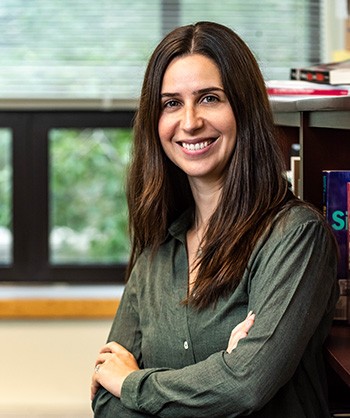
Gabrielle Oliveira, (she/her/hers) Contemporary Ethnography and Inequality Workshop Faculty Director, is the Jorge Paulo Lemann Associate Professor of Education and Brazilian Studies at the Harvard Graduate School of Education. Gabrielle’s research focuses on immigration and mobility — on how people move, adapt, and parent across borders. Her expertise includes gender, anthropology, transnationalism across the Americas. Merging the fields of anthropology and education through ethnographic work in multiple countries, Gabrielle Oliveira also studies the educational trajectories of immigrant children. She is the author of Motherhood Across Borders: Immigrants and their Children in Mexico and in New York City (NYU Press). The book has won the inaugural Erickson and Hornberger Book Award by the University of Pennsylvania's Ethnography Forum and the award for book of the year by the Council of Anthropology and Education.
Originally from São Paulo, Brazil, Gabrielle received her M.A. and Ph.D. from Teachers College, Columbia University in New York City. She was the recipient of the National Academy of Education/ Spencer Foundation Dissertation Fellowship, and she has been also awarded a postdoc fellowship from the National Academy of Education/Spencer Foundation to study the consequences of the 2018 zero-tolerance policy on family separation under the Trump Administration. Oliveira is also part of a group called "Colectiva Infancias" that has won a grant from the National Geographic Foundation to assemble a public-facing website on the stories of immigrant children who migrate within the Americas.
Gabrielle has been engaged in studying Brazilian migration to Massachusetts and has extensively focused on how immigrant children and families navigate newfound educational systems amid a global pandemic. She has worked closely with teachers in dual language programs whose students are Brazilian working to understand what the constraints are in educational practices in and out of classrooms. Her publications can be found in journals like Anthropology and Education Quarterly; Diaspora, Indigenous, and Minority Education; Bilingual Research Journal; TESOL Quarterly; Global Studies of Childhood; among others. For information on Motherhood Across Borders: Immigrants and their Children in Mexico and in New York City, please see this Boston College 2018 interview: https://www.youtube.com/watch?v=K_TUUA-aHAw.

Dahlia Showalter (she/they), Contemporary Ethnography and Inequality Workshop Faculty Director, is an Assistant Professor of Sociology at Harvard University. Dahlia uses ethnographic and qualitative methods to study illicit drug use and the legal, medical, and social institutions that manage it.
Dahlia's first book asks how rural social conditions, including geographic isolation and dense social networks, affect how people buy, sell, use, and try to quit opioids. It is based on two years of ethnographic fieldwork and in-depth interviews with people who use drugs and local practitioners in several nonmetropolitan counties in California. Dahlia’s research has been published in Social Science & Medicine, Theory & Society, International Journal of Drug Policy, Mobilization, and elsewhere. She holds a PhD in Sociology from the University of California, Berkeley.
In addition to their academic work, Dahlia has volunteered with harm reduction services organizations in Illinois, California, and Massachusetts for over fifteen years.
____________________________________________
The Contemporary Ethnography and Inequality Workshop was previously directed by: Roberto G. Gonzales, Richard Perry University Professor of Sociology and Education at the University of Pennsylvania; Ieva Jusionyte, Watson Family Associate Professor of International Security and Anthropology at Brown University; and Kaya Williams, Professor of Anthropology at Barnard College. Christopher Winship previously supported the CEI Workshop as Faculty Sponsor.
WORKSHOP COORDINATORS
Major Eason is a PhD student in Sociology. His research interests are broadly centered around environmental justice and sustainable development. Namely, he looks to garner a place based understanding of how environmental racism – racial inequality in the environmental quality and sustainable infrastructure of communities – manifests and how local communities respond to said issue.
Major earned his BA from Swarthmore College, where he double majored in Sociology and Economics and was a Mellon Mays Fellow. As a fellow, he embarked on a project that built off of Robert Bullard’s landmark case study of environmental racism in the East Little York section of Northeast Houston. Drawing off the 1983 study, which originated from community protests against the Whispering Pines Landfill, Major used historic census tract data and interview data to understand demographic shifts, community relationships, and residents’ sense-making around the environmental hazard in their neighborhood.
